
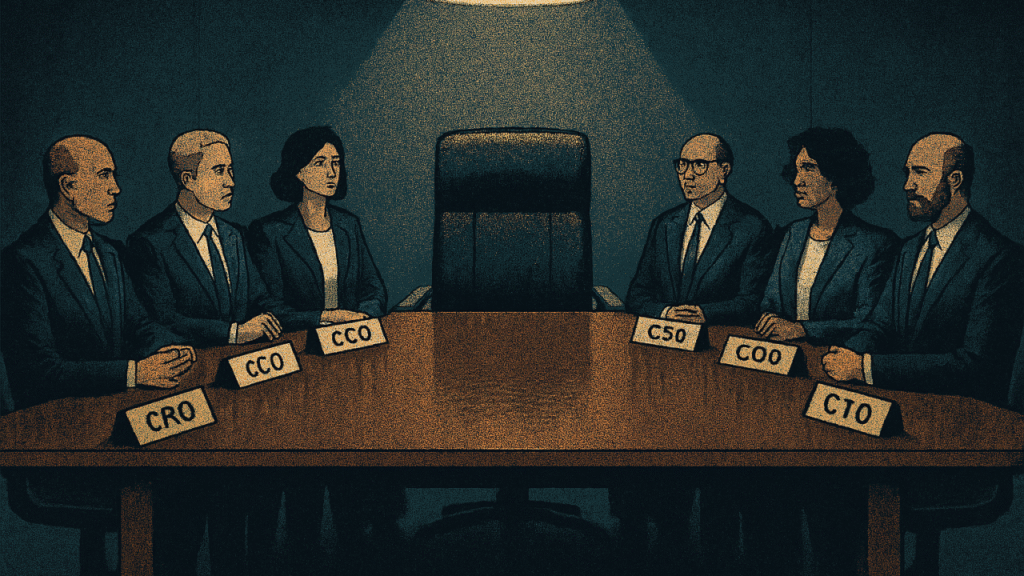
You Have a Chief for Everything. Except the Thing That Matters Most.
You have a Chief Risk Officer to protect what you built. A Chief Compliance Officer to make sure you follow the rules. A Chief People Officer to keep everyone happy. You even have chiefs for sustainability, diversity, and digital transformation.
But who is fighting for your growth?
Nobody. And that silence is deafening.
The C-Suite Is Busy. But Is It Growing?
The average Fortune 500 company now has 17 C-suite titles — nearly double what it had two decades ago. Boards keep adding chiefs like they’re collecting trophies. Every new risk gets a title. Every new regulation gets a guardian. Meanwhile, the one thing that actually funds all of those salaries — business growth — gets handed off in pieces to Sales, Marketing, Product, and Finance, with nobody truly owning it.
We’ve built the most sophisticated leadership structures in corporate history. And somehow, we forgot to put someone in charge of growth.
That’s not a strategy gap. That’s negligence.
The Dirty Secret of the Modern C-Suite
Here’s what nobody wants to admit in the boardroom: most companies don’t have a growth strategy. They have a revenue target dressed up as one. Sales is chasing quotas. Marketing is chasing impressions. Product is chasing roadmaps. Finance is chasing margins.
Everyone is running fast. But running in different directions isn’t growth — it’s chaos with a good quarterly report.
72% of organizations say they are working toward long-term strategic goals but lack the unified leadership to achieve them. Read that again. Nearly three-quarters of companies are flying blind on the one thing their survival depends on.
Enter the CBO — The Chief Everyone Should Have Hired First
The Chief Business Officer is not another box on the org chart. The CBO is the executive who asks the question every other chief avoids: are we actually growing, or just staying busy?
Partnerships. Market expansion. Revenue architecture. Scaling. The CBO owns the full growth engine — not just a cylinder of it. They sit at the intersection of strategy and execution, connecting dots that siloed chiefs can’t even see from their corners of the org chart.
This isn’t theoretical. Over 68% of late-stage startups and 40% of Fortune 100 companies have added a CBO role in the last five years. In 2024, the tech sector alone saw a 48% surge in CBO hiring. Even Airbnb — a company that knows a thing or two about scaling — created a dedicated CBO role to lead its expansion strategy. The smartest companies aren’t debating whether they need a CBO. They’ve already hired one.
The ROI of Owning Growth
Companies with a dedicated business transformation executive report an average 14% ROI on strategic initiatives. That’s not a rounding error. That’s the gap between a company that scales and one that slowly, quietly becomes irrelevant.
Your CRO is protecting your downside. Your CFO is optimizing your present. Your CTO is building your future.
But without a CBO, nobody is selling that future. Nobody is opening the doors, striking the deals, entering the markets, and building the partnerships that turn your vision into a revenue line.
The CEO of Growth
If the CEO sets the vision, the CBO makes it commercially inevitable. They are the CEO of growth — the one executive whose entire mandate is making sure the company is bigger, stronger, and more valuable next year than it is today.
In an era of AI disruption, geopolitical volatility, and shrinking attention spans, hoping that growth will emerge organically from the sum of your functional parts is not a strategy. It’s a wish.
Stop collecting chiefs. Start building growth.
The most dangerous gap in your C-suite isn’t a missing risk officer or a second CFO. It’s the absence of someone whose sole obsession is making your business grow.
That’s the CBO. And if you don’t have one — your competitor is about to.