
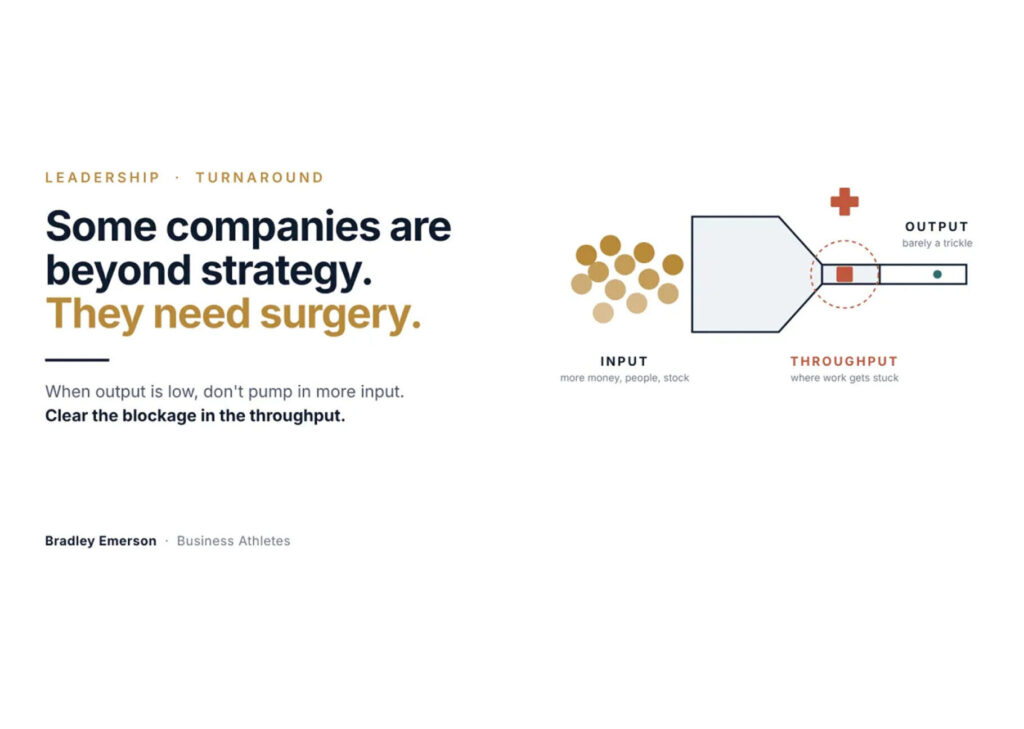
A recent coaching call with a business owner reminded me of a mistake I have seen companies make for over three decades.
When output falls, the instinct is to increase the input.
Sales are down, so we hire more salespeople. Production is behind, so we buy more machines. Cash is short, so we borrow more. The marketing budget goes up, more stock is ordered, another branch is opened. Then everyone waits for the output to rise.
It rarely does. More often, the company chokes.
The problem is rarely the input
Every organisation works in three stages: input, throughput and output. Money, people and materials go in. Work flows through the organisation. Results come out.
When output is low, most leaders look at the two ends they can see. But the problem usually sits in the middle, in the throughput: the way work actually flows through the organisation.
Eliyahu Goldratt made this point decades ago in The Goal: a system can only move as fast as its slowest step. If the bottleneck is a slow approval process, a weak supervisor, a production line, a collections team or a single owner who must sign everything, then adding more input does not increase output. It piles up in front of the blockage.
More stock sits in the warehouse. More orders wait to be delivered. More invoices wait to be collected. More staff wait for decisions. And the extra borrowing that funded it all starts charging interest from day one.
You don’t treat a blocked artery by raising the blood pressure
This is why some companies are beyond strategy.
A strategy session assumes a healthy body that needs direction. But a company whose throughput is blocked is not a patient who needs a fitness plan. It is a patient with a blocked artery. Pumping in more blood, more money, more people, more products, only raises the pressure. Eventually something bursts. What that company needs is surgery: a precise, sometimes painful intervention to clear the blockage, before anything else is added.
How to find the blockage
Before approving another rupee of spending, another hire or another loan, leaders should ask:
- Where does work wait? Follow one order from the customer’s request to the cash in your bank account. Where does it sit idle?
- What is the slowest step? That step sets the speed of your entire company.
- How much work is done twice? Rework is throughput lost.
- Who must approve everything? In many companies, the bottleneck is the person at the top.
- Where is cash trapped? In stock, in unpaid invoices, in projects that never finish.
The operation
Surgery follows a clear sequence:
- Stop adding input. Freeze new borrowing, hiring and expansion until the flow is understood.
- Find and clear the constraint. Fix the process, move the decision rights, change the person or add capacity at the blockage, and only there.
- Cut what is diseased. Loss-making products, customers and units that consume throughput without returning value.
- Release trapped cash. Clear old stock, collect what is owed, finish or abandon stalled projects.
- Then, and only then, increase input and plan strategy. Once the blood flows freely, strategy becomes rehabilitation, not wishful thinking.
Strategy or surgery?
Not every company needs surgery. Many need exactly what a good strategy provides. But when output is falling and the answer has always been to add more, it is worth asking a harder question:
Does my company need a strategy session, or an operating theatre?
Through Business Athletes, I help leaders diagnose where their organisation is blocked and carry out the surgery needed before strategy can work. If your company is adding more and getting less, let’s talk.